Sunday, November 27, 2011

How to beat money-market returns as a silver investor

November 27, 2011
With the low rates currently paid to investors in the money market and in this very low interest rate environment, we have to look for original avenues to find how to protect our money returns.
We think that silver is a very good investment, and it was proven to be one of the best for the last ten years. Since its low at $4.01 per ounce in November 2001 to the last high of $49.87 reached in April 2011, we were tested with wild corrections in 2008 and 2011, each time of around 50% from the previous high.
Besides physical silver, the best vehicle to use for silver investment is the SLV which is an ETF (exchange trading fund) for 1 ounce of silver. Friday 11/18/11’s close was $31.40. This year’s low was $27.41 (09/26/11) and the high was $48.35 (04/28/11).
In this financial world of debt crisis which saw the U.S. Federal Reserve come to help with two Quantitative Easing interventions  (QE1 in 2009 and QE2 in 2010), we think that the next QE3 will happen when the stock market will again fall down dramatically. The shock of Europe’s waves are starting to hit U.S. shores. When QE3 will be implemented, the stock market should stabilize and silver should shoot up. (After QE2, silver went up from $18 to almost $50 in the space of eight months.)
This is what we propose to do for those investors who accept to allocate 5% of their portfolio to a potential silver purchase: We will use the strategy of selling put options on silver. For example, when we sell an SLV put option at a strike price of $25, we are committed to buying silver below $25. If silver stays above the strike price of $25, at option expiration we will keep only the option premium which was given to us when we sold the put. It is very important that we accept to allocate the total value of our commitment to buy silver at $25 in this strategy.
The above strategy in action:
On Friday 11/18/11, SLV closed at $31.40.
All examples don’t include commissions.
Two-Year Put Options
SLV $25 Put January 2014 (Expiration 01/18/14) closed Friday 11/18/11 at $4.50 (Bid). If at expiration, silver is below $25, we get delivered silver at $25 (20% lower than Friday 11/18/11’s close), and we have to pay $2,500 for the one Put we sold (1 option = 100 x $25). In the case silver is above $25, we keep the premium of $450 per option ($4.50 x 100). What was our return in this case? $450/$2,500 = 18% over two years (9% per year when the money market is giving us very low interest rates).
SLV $20 Put January 2014 (Expiration 01/18/14) closed Friday 11/18/11 at $2.60 (Bid). If at expiration, silver is below $20, we get delivered silver at $20 (30% lower than Friday 11/18/11’s close), and we have to pay $2,000 for the one Put we sold (1 option = 100 x $20). In the case silver is above $20, we keep the premium of $260 per option ($2.60 x 100). What was our return in this case? $260/$2,000 = 13% over two years (6.5% per year when the money market is giving us very low interest rates).
One-Year Put Options
SLV $25 Put January 2013 (Expiration 01/19/13) closed Friday 11/18/11 at $3.15 (Bid). Similarly to the previous examples, if at expiration silver closes above $25, the return will be 12.6% for 1 year.
SLV $20 Put January 2013 (Expiration 01/19/13) closed Friday 11/18/11 at $1.58 (Bid). Similarly to the previous examples, if at expiration silver closes above $20, the return will be 7.9% for 1 year.
If a more aggressive strategy is followed:
SLV $31 Put January 2013 (Expiration 01/19/13) closed Friday 11/18/11 at $5.80 (Bid). Similarly to the previous examples, if at expiration silver closes above $31, the return will be 18.7% for 1 year.
Short-Term Put Options
SLV $25 Put December 2011 (Expiration 12/17/11) closed Friday 11/18/11 at $0.21 (Bid). Similarly to the previous examples, if at expiration silver closes above $25, the return will be 0.8% for one month (an annualized return of 10%).
SLV $25 Put January 2012 (Expiration 01/21/12) closed Friday 11/18/11 at $0.54 (Bid). Similarly to the previous examples, if at expiration silver closes above $25, the return will be 2.16% for two months (an annualized return of 13%).
SLV $25 Put February 2012 (Expiration 02/17/11) closed Friday 11/18/11 at $0.84 (Bid). Similarly to the previous examples, if at expiration silver closes above $25, the return will be 3.3% for one month (an annualized return of 13.4%).
Conclusions:
In all these examples, we will not own silver at all if the market never goes below our put’s strike price at expiration. However, the amount allocated for the silver in the case of expiration below the strike price should still bring us a better return than if it were sitting in the money market.
The January 31, 1980 silver price (adjusted for inflation by the CPI) was $139.98. In the present economic environment, allocating 5% of your portfolio to silver (Friday’s SLV close was $31.40) and 5% to the above strategy should at maximum keep you invested at 10% in silver which has been one of the best investments during the last 10 years. Only the very unlikely but catastrophic scenario of a depression hitting us all could derail this investment’s profitability.
Everyone should remember that silver was money until 1961!…

Sunday, July 31, 2011

The debt ceiling battle

I think that John Boehner and every one in Washington should, "Get your head out of their ass and do some good for us"..  If your looking to cut cost you should look at cutting all aid over seas and pet projects that every one is doing..  START their first and see what you can come up with!!

The whole USA is not happy with the little games that are NOW taking place and it seam that no one is doing their job that we sent them to Washington to do!!

Man up and do what is right!!

Saturday, February 5, 2011

Gold or Silver which one to invest in??

It seam with gold fulling from the 1400 mark to around 1348 silver still going strong still up in the 29 mark. I think silver is the best way to go for now..

US Trade dollars are a good investment to look at as well as any type of silver dollars or any silver coins that have about 90% silver..  From the 1873 up to about 1885.

Wednesday, January 12, 2011

When Will Gold and Silver Go Down?


Gold and silver are in a bubble, if the bulk of economists and financial pundits are to be believed. With no dictionary definition of what exactly a financial bubble is, we are left to our own devices to interpret the significance of such a proclamation according to our own experiences.

Lets say we consider a bubble the phenomenon whereby the prices paid for a given commodity, be it homes, coffee, copper, rubies or tulips, rises rapidly relative to an average market history timeline as a result of sudden and irrational investor demand, and then shortly thereafter sees a price collapse to a point lower than when the bubble started.

Consistent with all commodities that can have been categorized as recipients of bubble phases over the last 200 years is that at that onset of the bubble formation phase, the utile value of the commodity in question becomes the subject of elevated speculation in anticipation of an increase in demand as a result of a predicted rise in utile consumption.

In the bubble phase price curve, the steepness in the growth phase is exacerbated when the predicted increase in utile demand materializes, or is exceeded, which in turn fuels speculative demand for the commodity and its derivatives (ETFs, Futures, Options, etc).

Without exception, when speculation combined with enhanced utile demand take prices for the commodity to such high levels that they start to negatively impact utile demand (as replacements are sought and/or fresh momentum forms in supply to capture the advantage of elevated prices and margins), the demand curve weakens, which generally triggers a massive bolt for the exits of the specs who are most on top of that data, which in turn starts a chain reaction whereby successively more distant speculators from the negative data source panic and sell as the price drop accelerates, precipitating the proverbial popping of the bubble.

That, in essence, is the bubble life cycle as it applies to commodities.

Bubbles were once more or less the result of natural market forces, the cyclical essence of markets driven by supply and demand. With the advent of Massive Capital Concentrations (multi-billion dollar investment funds, mutual funds, hedge funds, sovereign wealth funds, private wealth trusts etc), the effect on commodity prices from these speculative positions far exceeds, in many cases the potential effect from fluctuations in utile demand.

Now banks, and their very close and incestuous relative, hedge funds, are generally in a position to occupy two distinct advantage points over Joe Blow investor on the street. A), they have greater access to capital, and B) they have superior access to data. In speculation, information is everything.

Up until the age of computers and internet, which changed data and information transfer, as well as data and information analysis and strategy extraction, from long timeline processes to near instant timeline processes, MCC’s used their large capital positions to clumsily influence bubbles great and small by distributing data selectively and manipulating market volumes and price movements sloppily.

Now in the era of instant data flow and algorithmic decision processing, not only can MCC’s encourage bubbles with surgical precision, they can very deftly manage the curves associated with the bubble phases. Profit is maximized when you can buy your entire position at the low, and then sell all or as much as possible at the high. Then, if you are in a position to control markets, you go massively short at the high, knowing that your influence and your capital resources will both drive the bubble pop phase into a nosedive, but you will be able to suck up all the shares all the way down, or at least half way down, covering your short when all the Joe Blow suckers sell you all their stock in utter desolation, not understanding that they’ve been played like a tiny little fiddle.

The two commodities on the planet that are the exception to qualification for this scheme now, is gold and silver. And that’s because they have an intrinsic monetary value that all other commodities lack.

A thing can only be said to have monetary value if it is universally (globally), or nearly universally, accepted as a medium of exchange for goods and services. There are very few people on the earth who would not take gold or silver as payment for a service or good they were interested in selling. But only very specialized traders will take a barrel of oil off your hands or a skid of copper cathodes or a house or equities as a form of immediate payment for anything they might want to sell. This is the primary fallacy in the mainstream financial media’s categorization of gold and silver as mere commodities. They are not. They are disqualified from that definition because of their intrinsic monetary value.

And it is precisely that monetary value that prevents MCC’s from participating any longer in the precious metals markets. The transactional volume in the physical gold and silver markets is puny. ETF’s generally preclude manipulation because they need to take delivery of the physical gold and silver, unless they are ETF’s based on derivatives, which are intrinsically worthless and most likely to collapse if they incorporate any kind of short/hedge strategy.

The prices of both gold and silver have long been subject to price manipulation for various reasons.

Most recently, silver has been the target of ebb and flow bubble manipulation schemes that have more or less been caught red-handed by serious market analysts who scream and shout from their hilltop epicenter embodied in the Gold Anti-trust Action Committee.  Gata has been stridently screaming to anyone who would listen (which was mostly no one for the last decade) since 2000 that gold was being methodically price suppressed to impart the perception to the market by the largest criminal enterprise on earth, the U.S. Federal Reserve and the United States Treasury, that the U.S. dollar was a well managed and healthy currency.

As we now almost universally know, that is not the case.

One must be diligent not to buy the pure propaganda that emanates from the top universities on down to the Wall Street Journal that the Fed is an independent private enterprise. It is only private and independent in that it is not subject to the oversight and laws governing Federal Financial Institutions. Its influence, abuse, and fraudulent manipulation of markets and global economic public perception while using the public coffers of the United States citizenry makes these two institutions unequivocally a single criminal enterprise operating as public institutions.

The now famous manipulation of silver prices in an effort to “corner the market” by the Hunt Brothers in the 80’s, and JP Morgan’s incrementally growing infamy as perpetrators of the latest fraudulent silver market manipulation, share as their motive only profit.

Gold, on the other hand, whose motive for participation in a scheme perpetrated by the Fed, the U.S. Treasury, certain banks, and possible a certain major gold producer, were in the past initiated for profit, and I suspect that the value of the enterprise in orchestrating confidence in the U.S. dollar throughout the past decade was initially a serendipitous discovery that was promptly deployed as a weapon.

In any case, the CFTC’s increasing metamorphosis into a serious regulator from a puppet facilitator of such schemes has resulted in JP Morgan exiting the scheme largely as credible class action lawsuits from fleeced investors are empowered by the CFTC’s own statements and findings. The outcome of that is decreasing macro and micro volatility (week to week) in both markets, and increasingly steady incremental price increases – especially in the macro view of the last decade). The ability to influence supply remains fixed at substantially less than 5% per year, thanks to the unavoidable difficulty in sourcing and extracting new supply. Therefore, the possible market, and potential bubble, cannot reach a sufficient size in terms of volume to accommodate the requirements of MCC’s. They need massive volume of the physical commodity, and more importantly, an exponentially larger derivative market, that they can control and influence by virtue of the fact that they own the clearing houses and up until recently, the regulators who helped these markets stay ‘dark” or non-reporting.

The one downside as far as MCC’s are concerned with the new instant world is that with comes increased transparency, whether they want it or not. The bigger an organization becomes, the more it must cannibalize itself to continuously evolve efficiently. People get fired, bumped, overlooked for promotion, shut out of deals, not invited to parties – all these things have the effect of originating new competing MCC’s as resentment causes former members of MCCs to take their contacts with them and form new MCC’s. The seeds of destruction of MCC’s are thereby built into them in the form of egos. The one time the ruthless efficieny required from within MCC’s gets trumped is when somebody’s ego gets bruised. Thus Wikileaks. Thus Black Swans. Thus Bear Stearns and Lehman Brothers.

Wending our way back to the gold and silver issue, the underlying commodity markets for gold and silver are limited, and now, thanks to the whole idea of position limits and transparency and reporting for derivatives markets, the size of any given derivative market must needs be directly proportional to the possible size of the underlying commodities market.

Gold and silver exempt themselves from that manipulation because of their monetary aspect. They are complicated by their dual function designations. They are each money, and an industrial ingredient that is consumed. Because they are in growing demand as monetary stores of value as a direct result in the appropriately crumbling confidence in the U.S. dollar, the pound sterling, the Euro, the yuan, and the yen, which collectively constitute the 5 major currencies of global trade, they are sought increasingly (and somewhat ironically) by MCC’s whose primary mandate is value preservation (Sovereign wealth, private wealth) as opposed to more speculative MCC’s (private equity buyout funds, hedge funds, investment funds) whose continued existence depends more on their ability to generate profit in some risk/reward ratio configuration that attracts their investors.

What is happening then, is gold and silver have left behind the human evolution point where they could be easily manipulated, and are increasingly resuming their primary roles as the primary medium of exchange for global trade. MCC’s are holding gold, silver and their derivatives, bought only as cash equivalents because they are now the lowest risk currencies to hold out of all the global currencies. ETFs are, in essentially, a return to the original form of banking, whereby a certificate was issued to the bearer on whose behalf the bank was storing a quantity of gold equal to that stipulated on the certificate.

Gold and silver are re-asserting themselves, in fact, as the only real money,(in terms of the definition of a globally accepted medium of trade) whose supply cannot be arbitrarily influenced by any single government, MCC, or special interest group. The more this awareness permeates the global general consciousness, the more that awareness will drive demand. Fringe pundits are absolutely right when they predict an exponential explosion in the prices for gold and silver. Never mind $2,000 an ounce, or $5,000 an ounce. I’m increasingly convinced that $30,000 to $50,000 per ounce for gold will be seen in this lifetime, especially as fiat currencies based on nothing are abandoned for mediums that more directly represent a real monetary asset, like gold and silver bullion.

Friday, December 31, 2010

Happy New Year

This is wishing every one a Happy New Year and lets hope that Gold and Silver will cont to new highs..

Tuesday, December 28, 2010

Gold futures jumped as much as 1.7% on Tuesday, reclaiming the $1,400-an-ounce level, as the dollar fell against a broad range of currencies.

The dollar index /quotes/comstock/11j!i:dxy0 (DXY 80.29, -0.08, -0.10%) , which measures the greenback against a basket of six major currencies, fell as low as 79.956 earlier, from 80.34 in North American trading Monday. It lately traded around 80.396. Read about dollar.
The came under pressure earlier in the day after the Case-Shiller index tracking home prices in 20 U.S. metropolitan areas fell in October by more than analysts had predicted. See story on home prices.
Metals, along with other commodities priced in dollars, often trade inversely to moves in the greenback because otherwise the currency move would reduce the value of the commodities. Investors have flocked to metals, especially gold, this year, on a combination of their desirability as an alternative asset and as a hedge against the risk of future inflation.
Gold hit a record high earlier this year and is up 28% for the year.
Silver — a cheaper alternative to gold — has skyrocketed nearly 77%.
Copper also has appeal as an industrial metal that tends to benefit from global economic growth. It’s gained 29% this year.

Friday, December 17, 2010

Silver Forecast to Rise to $40/oz in 2011 and $400/oz by 2015


December 15th, 2010


Gold

Gold has fallen in dollars but is flat in sterling and euros this morning. Moody's has cut Spain's debt rating on contagion concerns which has seen the euro fall. Germany's opposition to further government financed aid is leading to tensions with the ECB, which is itself now under financial pressure and may need an increase in capital if it is to continue buying sovereign European debt.

Gold is currently trading at $1,388.70/oz, €1,042.18/oz and £886.54/oz.


Gold in USD – 30 Day (Tick)

The risk of contagion is real and many analysts believe the crisis will escalate early in 2011. This will lead to continued safe haven demand for gold and should see gold once again perform well in 2011.

The growing threat of inflation due to significant increase in commodity prices will also support gold. Cotton soared by its daily limit yesterday and copper reached new record nominal highs. Sugar prices have reached a 30 year nominal high and Portugal is experiencing a sugar shortage - the first European country to do so in 30 years.

Food and energy prices are rising internationally and the much heralded "wave of inflation" warned of for months may be gradually coming to pass.


Gold in USD – 1 Year (Daily)

Last night, the Federal Reserve, in a policy statement, said the economic recovery was still too slow to bring down unemployment, and reaffirmed its commitment to buy $600 million in government bonds. This will not do anything to restore faith in the dollar and will likely lead to commodity and precious metals making further gains. 

Silver

Predictions of higher silver prices in 2011 and continuing into 2015 came overnight. Standard Bank Plc said that they see silver at over $40/oz due to new applications and increased industrial demand.

James Turk of Gold Money said that he believed silver would reach over $400/oz in 2015. Turk believes that this price will be reached due to massive investment demand in silver due to a possible crash in the dollar and the emergence of inflation and potentially hyperinflation. Turk also believes that the massive concentrated short positions on the COMEX held by JP Morgan as alleged by GATA and Ted Butler will propel silver prices higher in a huge short squeeze. 

Silver is currently trading $28.99/oz, €21.76/oz and £18.51/oz.

Platinum Group Metals

Platinum is currently trading at $1,689.75, palladium at $744.00/oz and rhodium at $2,225/oz. 

Wednesday, December 15, 2010

Buy Gold and Silver Through a Commercial Bank and You May End Up With a Vault Full of Air by JS Kim

Recent news this week again proves that bankers are among the largest charlatans in the universe.

First Jim Rickards reported that a Swiss bank refused to deliver roughly $40 million of gold bullion to a wealthy client for 30 days and only finally physically delivered his gold when the client brought in his lawyers and threatened to take his story to Reuters and other syndicated financial news networks. Then later this week, James Turk reported that he is aware of another individual that has been trying to take physical possession of approximately $550,000 of silver for two months now from a Swiss bank with zero luck. Turk further elaborated that the bank has been trying to pressure the client into accepting the cash equivalent market value of the silver rather than deliver the physical silver to the client. In both of these cases, I presume that neither of these Swiss banks ever held allocated gold and silver for their clients or if they did, had then leased out the gold/silver or sold the same gold/silver to multiple clients, and thus were forced to stonewall their clients until they could secure the physical metal. Why else would a bank take 30 days to deliver something that was supposed to be sitting in a vault in an allocated account?

Of course, none of this is really shocking as the two above cases merely mirror the circumstances of the 2005 class-action lawsuit against Morgan Stanley in which Morgan Stanley told its clients it was selling them silver in allocated accounts and storing it in its vaults. However, when one of their clients, Selwyn Silberblatt, demanded physical delivery, Morgan Stanley failed to deliver, prompting the class-action lawsuit. Morgan Stanley eventually settled the lawsuit for $4.4 million. Time after time, bankers have been caught committing likely fraud regarding the sales of gold and silver. This likely fraud extends to more than physical sales. In the futures markets, bankers have been discovered to be selling 100 ounces of paper gold for every one ounce of physical gold that actually exists in the market. With PM ETFs, it is highly likely that multiple claims exist on whatever physical gold and silver back the GLD and SLV, if any physical gold and silver even back them at all.

In addition, it’s not just banks you have to worry about these days. The incidence of counterfeit gold coins and silver coins is on the rise along with the recent steep rise in the gold and silver price. The Financial Times recently reported that a wave of hard to detect counterfeit gold coins is now coming out of China. Say goodbye to the days of gold-plated tungsten and say hello to a more complex counterfeit gold alloy consisting of 51% gold mixed with osmium, iridium, ruthenium, copper, nickel, iron, and rhodium. Tungsten is a hard, brittle grey metal that has the same density as gold but none of gold’s characteristic softness. The new fake gold apparently not only has a density similar to the real thing but also has a near identical softness and color, qualities that suggest that metal smiths with an extensive knowledge of metallurgy are producing the new fakes. In fact, Haywood Cheung, president of the Chinese Gold & Silver Exchange Society, Hong Kong’s century-old bullion exchange, said goldsmiths and jewelers in Hong Kong had recently been duped into buying between 200 and 2,000 ounces of the new fake gold.

In conclusion, if you want to ensure that you actually possess real physical gold and real physical silver, take two steps.

(1) Never entrust a bank to hold your physical gold and silver or you may end up sitting on a vault full of nothing but air; and
(2) When you buy from an independent dealer, perform your due diligence to avoid purchasing fakes
.

Friday, December 3, 2010

Price of Gold and Silver

WOW!! Did you notice the pricing of gold and silver today??

Gold is once again above the 1400 mark coming in at $1413.69 / oz
Silver is making it way up to 40 mark coming in at $29.39 /oz

Got to love this market!!

Tuesday, November 30, 2010

Junk Silver Coins

Junk Silver Coins for sale
Circulated 90% US silver coins, minted before 1965, are often called junk silver coins.  A "bag" ($1000 face) contains approximately 715 ounces of silver and generally tracks the spot price of silver. If silver goes up ten cents, a bag of US silver coins rises $70 or so; however, junk silver coin prices sometimes lag sharp spot price changes.
Why Buy US Silver Coins?
Although many investors buy junk silver coins as bullion investments, other investors buy junk US silver coins for "survival purposes." These buyers fear the worst for the dollar, that it will be printed until it becomes worthless. If this "worst-case scenario" were to become reality, then US silver coins would be used the purpose they were originally minted: as money.
CMIGS hopes that Americans never see the day that their once proud dollar becomes worthless. Yet, we are aware that the history of paper currencies is that they are printed until they become worthless. (Actually, today the most dollars in circulation are not printed but are "electronic" or digital dollars, created by the Federal Reserve.)
Junk Silver Coins or Bullion Bars?
Although pre-'65 silver coins would be ideal for survival purposes, when junk silver coins sell at premiums below premiums on 100-oz silver bars and 1-oz silver rounds, junk silver coins hold greater upside price potential than .999 fine silver bullion products. At times, and especially during rising precious metals markets, circulated pre-'65 US silver coins pick up premiums.
On the other hand, .999 fine bullion items (1,000-, 100-, and 10-oz bars and 1-oz rounds) can be produced at any time; consequently, there are limits as to how high premiums on .999 fine silver bullion items can go. To support the assertion that bags of US silver coins hold greater upside potential than .999 fine bullion items, a little background on junk silver coin prices and silver prices is in order.
Over the last three decades, when precious metals enjoyed bull markets, US silver coins often achieved premiums of $1.20/oz to $1.50/oz over spot, sometimes as high at $2.50/oz. That is because many investors want silver in a form that they know is silver, and pre-1965 US silver coins certainly fit the bill.
In the 1980s, following silver's spike to $50/oz, industrial silver users implemented efficiency moves that slowed industrial demand for silver. Further, the rising prices of the 1970s had spurred efforts to mine more silver and to increase the recovery of silver in the secondary market. (Today, reclaimed silver is a major source of this essential metal.)
Because of these efforts, silver went into "surplus" in the 1980s, i.e., newly refined silver exceeded industrial demand. This caused investors to avoid silver in the '80s, except for a strong market in 1987. For most of the 1980s, investors were net sellers of silver, which resulted in huge quantities of junk silver coins being refined and converted into .999 fine silver. The Y2K scare caused another huge melting of circulated 90% silver coins.
 
Y2K Buying Spurs Junk Silver Coin Buyers
Fearing that the world's computers would quit working on Januarys 1, 2000, many people began preparing for the worst. Their fears were exacerbated as respected economists issued warnings and wrote books. Newsletters were dedicated to teaching people how to prepare. One recommendation was that circulated US silver coins be stashed away so that they could be used as money when banks closed and ATMs no longer spewed $20 bills.
Consequently, in 1998 and 1999 people fearing Y2K bought junk silver coins at whatever prices, and bags picked up 50% premiums. The Y2K scare showed just how quickly US silver coins can pick up big premiums and that premiums on 90% silver coins can rise while the price of silver remains stagnant. During 1999, the price of silver was essentially unchanged.
Silver Eagles, Silver Maple Leafs as alternatives
Other popular alternatives to junk silver coins during the Y2K buying were the US Mint's Silver Eagles. Silver Maple Leafs, which are Canadian silver coins minted by the Royal Canadian Mint were popular with Y2K buyers who lived along the Canadian border. Overall, Silver Eagles were much more popular and remain more popular today than Silver Maples Leafs.
Y2K Buyers Start to Sell
On January 3, 2000, as soon it became evident that the world's computers were not going to fail, investors began selling, and they sold throughout the year and into 2001, forcing down prices on US silver coins until they sold at discounts (below the value of their silver content). Untold quantities of bags were refined into .999 fine silver bullion, and now bags of pre-1965 US silver coins are in short supply.
Before Y2K, an order for 100 bags of junk silver coins could be filled with a phone call to any one of several wholesalers. By the first half of 2002, an order for 20 bags often took two or three phone calls.
While junk US silver coins held huge premiums during the Y2K buying frenzy, many CMIGS clients-at our urging-swapped their junk silver coins for 100-oz bars or 1-oz rounds and increased their silver holdings by 35% to 45% without laying out additional cash.
After Y2K became a nonevent, the premiums on bags of  US silver coins fell to where junk silver coins became cheaper than 100-oz silver bullion bars. Still, the potential for 90% silver bags to pick up big premiums justifies the buying of bags circulated silver coins by investors who can handle the bags' weight and bulk.

Sunday, November 28, 2010

Buying silver, buying silver bullion for survival purposes

Silver coins and silver bullion also discussed
Investors buy silver coins, silver bullion coins, and coin silver for one of three purposes: as an investment, as an inflation hedge, or for survival purposes. Investors who buy for investment purposes look for price increases because of silver's supply/demand fundamentals. For example, in 1998 Warren Buffett purchased 129.7 million ounces of silver for Berkshire Hathaway, a holding company that Buffet heads.
Buffett's silver purchase, which became legendary among silver investors, was probably for investment purposes. However, it may have been an inflation hedge; Buffett did not say. In fact, Buffett said very little about his silver investment, even after he disposed of it. One thing is certain, however, Buffett did not buy 129.7 million ounces of silver for survival purposes.
Buying silver bullion as an inflation hedge
Investors who want protection against inflation buy silver and gold as inflation hedges. During the 1970s, silver and gold prices skyrocketed in response to price inflation that reached 13%. During the '70s, popular silver and gold investments included any form of silver bullion, from 1-oz silver rounds and pre-1965 U.S. 90% silver coins to 100-oz silver bars and 1-oz Krugerrand gold coins. When the Federal Reserve brought inflation under control in the 1980s, much of the silver bullion and the gold coins purchased in the 1970s were sold and the proceeds put back in paper investments.
Silver coinsfor the worst-case scenario
Investors who buy silver and gold for survival purposes fear the worst. Those fears include the Federal Reserve printing so many dollars that the dollar will become worthless, which is the history of all paper currencies not redeemable in gold or silver. Fear of a financial meltdown, which would close banks as in Argentina and Paraguay in 2002, is another.
Argentineans and Paraguayans who had to foresight to bail out of the banking systems and convert their assets to gold or coin silver were protected. Not only did banks close, but also when they reopened depositors were limited in the amount of money they could withdraw. Meanwhile, the Argentinean peso and the Paraguayan guarani sank in value. Shortly after those crises, Brazil defaulted on its international debt and its paper currency, the real, sank.
Those are the kinds of situations that investors who buy coin silver and small gold coins for survival purposes want to protect against. In doing so, these investors buy silver and gold in forms that can be used for money or to barter for goods and services.
Buying silver bullion and silver coins for barter

Small gold coins for barter
The best forms of silver for survival purposes are pre-1965 U.S. 90% silver coins and 1-oz silver rounds. The most useful forms of gold would be fractional-ounce gold coins, such as the 1/10-oz Gold Eagles, the 1/10-oz Krugerrands, the 1/4-oz Gold Eagles and the1/4-oz Krugerrands. But, before going forward, it is imperative that we discuss which coins to avoid. That is because hundreds of web pages promote numismatic and collector coins, as well as foreign coins. Such coins are simply wrong for survival purposes.
If the time ever comes that silver coins and gold coins were again used as money, coins would be worth only their metal content. Numismatic (collector) premiums would disappear. Anyone using gold or silver coins to buy goods or services would not be asked, "What's the mint mark on your coin?" Nor will they be asked, "When was it minted?" The question would be, "What's the gold content?" Hand someone a St. Gaudens and tell him it contains .9675 ounce of gold, and it will be difficult--if not impossible--to convince him to accept it at more than .9675 times the price of gold.
Numismatic premiums are fleeting in normal markets. (See our Double Eagle coins page.); you may also want to read our Myths, Misunderstandings, and Outright Lies page, which exposes the tactics used by telemarketers.  Additonally, The Dangers of Buying Gold is a short warning about buying from telemarketers. Numismatic coins are bad investments for the average investor anytime; for survival purposes, they are simply wrong.
If you ever need to use your silver and gold to buy goods and services, you will want silver coins and small gold coins. Additionally, those coins should have certain characteristics to ensure they are readily accepted. First, survival coins should be stamped in English. Most Americans do not read foreign languages.
Second, the coins should have their gold or silver contents stamped on them; except for the modern bullion coins, most do not. In an emergency, having the gold content stamped on a coin could go a long way toward causing someone to accept it.
Bartering with silver coins
If your furnace goes out in January, the local heating guy may have never seen a gold coin before. If you hand him a $20 St. Gaudens, how does he know it contains a little less than an ounce? If you try to get him to take British Sovereigns, how can you prove they contain .2354 ounce each? Try convincing the guy at the auto parts store that a French 20 franc contains .1867 ounce of gold.
Third, the coins you buy for survival purposes should contain amounts with which Americans are comfortable. Americans understand one-ounce, 1/2-ounce, 1/4-ounce, and 1/10-ounce coins. Americans do not easily grasp the concept of .2354 ounce or .1867 ounce.
For survival purposes, avoid arcane foreign gold coins. (Despite more British Sovereigns having been minted than any other coin, Sovereigns are not well known in the U.S.) Simply buy the popular modern bullion coins. Krugerrands are the cheapest and best known. American Eagle gold coins are also readily recognized in the U.S., but carry higher premiums (markups over spot) than Krugerrands.
Both Krugerrands and Gold Eagle come in four sizes: one-ounce, 1/2-ounce, 1/4-ounce, and 1/10-ounce. For more information, visit our Modern Gold Bullion Coins page. (If you have been told that bullion coins are subject to confiscation and that old U.S. gold coins and/or foreign coins dated before 1933 are exempt, you really need to read Myths, Misunderstandings, and Outright Lies.)
Another plus for Krugerrands and Gold Eagles is that both are basic bullion coins and sell at small mark-ups over the value of their gold content. Generally, however, Krugerrands carry lower premiums than Gold Eagles, but both Krugerrands and Gold Eagles carry smaller premiums than foreign coins of comparable sizes. And certainly, Krugerrands and Gold Eagles are cheaper than old U.S. gold coins.
Silver bullion or gold bullion?
Finally, the question arises whether to buy silver or gold. Probably both, but if you are investing $10,000 or less, go exclusively with one-ounce silver rounds or circulated pre-1965 UD 90% silver coins. Pre-1965 U.S. 90% silver coins are commonly called junk silver coins because they have no collector value and trade for the value of their silver content. If you are investing larger amounts, say $30,000 up, you may want silver and gold.
If conditions were to deteriorate to the point that silver and gold re-emerged as the preferred forms of money, you would want lots of small silver coins. If you were buying canned food, you would need silver coins because gold coins, even 1/10-ounce ones, would have great value. If you have only silver coins and need to buy something of high value, then you simply trade a larger number of silver coins.
At current prices, an investment in silver results about fifty times the bulk and weight than if the same investment were made in gold. Therefore, large investments in silver create storage and handling challenges for some people. If storage and handling is a problem for you, then go exclusively with 1/10-oz Krugerrands or 1/10-oz Gold Eagles for the first $10,000 or so. Still, try to have some silver coins on hand.
Buy silver bullion coins or junk silver coins?
When buying for survival purposes, many investors have a tough time choosing between one-ounce silver rounds and junk silver coins. Rounds have their silver content and purity stamped on them. However, circulated pre-65 US. 90% silver coins once served as money in the US. and could do so again.
Actually, US. 90% silver coins were used for money in the US as recently as the late 1960s, and many Americans remember using them. Yet pre-65 silver coins do not have their silver content stamped on them, but if the dollar were repudiated people would quickly learn the value of pre-1965 U.S. 90% silver coins.

Another differene between 1-oz silver rounds and junk silver coins: With junk silver coins, you get many more pieces of silver. For example, a $1000 face value bag of junk silver contains right at 715 ounces of silver. Buy a bag of dimes, and you get 10,000 dimes; buy a bag of quarters, and you get 4,000 quarters. Buy 715 one-ounce silver rounds, and you get 715 pieces of silver.

Friday, November 5, 2010

Gold rallies to record, a whisper from $1,400

Gold rallies to record, a whisper from $1,400 and Silver’s at 30-year high; copper at its best in more than two years...

If you want to get in to the precious metals market you then should look at GLTR which is made up of 50% Gold, 30% Silver and 20% Platinum. Closed at $82.46 / per share..


Last week marked the launch of ETF Securities' Physical Precious Metal Basket of Shares (GLTR), a fund created to allow investors to obtain exposure to four precious metals in one go. To do this, 0.03 ounces of gold, 1.1 ounces of silver, 0.004 ounces of platinum and 0.006 ounces of palladium will back each share of the fund.
Given how stellar all the precious metals have performed as of late, the new fund sounds like a great deal. But is it?
Well, to understand that, first we must look at the metals themselves.
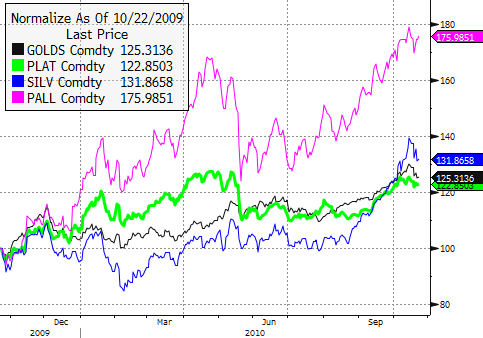
These days, the headlines analyze each up and down move in gold in excruciating detail — and for good reason: Gold is up 25 percent in the past 12 months. But it's not the only precious metal that is enjoying fabulous returns:
GOLD, PLAT, SILV, PALL - Normalized as of 10/22/2009
(Click to enlarge)
Platinum is the worst performer of the group, but even still, it's up almost 23 percent year-over-year. Silver has risen 31 percent, while palladium has jumped an astonishing 75 percent since this time last year.
Platinum
Let's look at platinum first. Platinum futures closed at $1,673 on Friday, up 11.5 percent since the beginning of the year, but not quite returning to their $1,731 highs, struck back on April 22.
Platinum prices are highly influenced by gold's moves, but increases in car sales, as well as general recoveries in both the stock market and jewelry sales, have helped rebuild demand for the metal.
On the supply side, a couple of strikes in South Africa have helped support prices upward. One strike at Northam Platinum (NOPLF.PK) had cut production to the tune of 1,000 ounces of metals a day (platinum, palladium, rhodium and gold) for 43 days. While the strike has since ended, the company expects it will take weeks to get the mine back to producing at full capacity. (Granted, Northam Platinum isn't anywhere near as large as other producers in the industry, but when the world's total annual supply of platinum is just 6 million ounces, any supply disruption will be felt.)
But increased supply could help pressure prices downward, too. For example, top platinum producer Anglo Platinum (AGPPY.PK) remains on target to meet its production target of 2.5 million ounces this year. The company, a unit of Anglo American, expanded its production in the third quarter by 11 percent, in an attempt to take advantage of platinum's increasing prices.
Anglo Platium isn't the only one bumping production in response to rising prices; a number of South African mines are planning on increasing production in the next few years. This includes Anooraq Resources (ANO), a junior miner in the country, which expects to double production at one mine, and already has plans to start a new mine forecasted to produce 300,000-400,000 ounces each year. Anooraq already owns the third-largest platinum reserve in South Africa, most of which is, at this point, largely untouched.
Silver
On Friday, silver closed at $23.290 — almost halfway back to its all-time high of $50/oz, hit back in 1980 when the Hunt Brothers attempted to corner the market. This time, however, silver prices are buoyed by a combination of factors, including gold prices, industrial demand and demand from investors.
In 2009, silver demand came mainly from jewelry demand (17.6 percent) and industrial demand (39.6 percent). According to the Silver Institute, investment demand for the metal (coins, bars, ETFs and so on) had grown by leaps and bounds last year, increasing over 180 percent from 2008 to 2009—but it still only made up 15 percent of total demand.
Still, silver investment continues to grow. As of Oct. 22, iShares Silver Trust (SLV) held 10,224 tonnes of silver in its vaults, whereas one month earlier, the trust had held 9,613.02 tonnes. That's a 6 percent increase in just 30 days.
As we've said so many times on HAI, silver is in a unique position compared to gold, because its demand is fueled not just by safe-haven paranoia, but also by industrial needs — so as the economy recovers, silver prices should maintain their rise.
And now that the investment community is increasingly interested in silver, that could also help support prices. An article from the Financial Times recently noted:
Hedge funds that are bullish about gold have begun taking positions in the silver market, aiming to profit from its higher volatility.
Palladium
Palladium is platinum's relatively cheaper sibling, and as such is used primarily in automotive and industrial uses. On Friday it closed at $598/oz, but many familiar with the metal are expecting prices to continue to rise in the coming months due to supply constraints — primarily from Russia.
In 2009, Russia supplied about around 42 percent of global palladium production — roughly 2.7 million ounces — some of which came from stockpiles the country had built up back when palladium was not yet in such high demand. But since Russian stockpile levels are state secrets, the question now is: How much of that stockpile remains?
Norilsk Nickel, itself responsible for around 39 percent of the world's palladium, doesn't think much remains of the Russian stockpile. "This year will be the last year when any substantial quantity from this stock has any chance to enter the market," said Norilsk Nickel's deputy general director for sales and distribution Viktor Sprogis in an article by Reuters.
Do You Need a Little GLTR?
Back to GLTR. So is it worth the metal it's based on?
First off, you need to look at why you want to invest in these metals. After all, the four metals are fairly well correlated, so holding all four won't give you much in diversification:
Security
PLATINUM
SILVER
GOLD
PALLADIUM
S&P 500
PLATINUM
1
0.754
0.638
0.803
0.536
SILVER
0.754
1
0.8
0.688
0.477
GOLD
0.638
0.8
1
0.52
0.23
PALLADIUM
0.803
0.688
0.52
1
0.588
S&P 500
0.536
0.477
0.23
0.588
1
Correlation of daily spot returns over 12 months, ending Oct. 22, 2010
Many investors choose to invest in silver, platinum and palladium because they believe these metals are undervalued compared to gold, and they want to play off that relationship. But by tossing gold into the basket, large gains (or losses) in the other metals may be tempered by even the smallest movements in the gold behemoth.
That's not even counting the fact that ounce for ounce, there isn't nearly as much platinum or palladium in the basket — meaning GLTR doesn't exactly offer much in the way of exposure to these metals, comparatively.
Besides, many silver, platinum and palladium investors want to work these metals' volatility, hoping to buy low and sell high on any given transaction. But going with a basket of metals just doesn't allow you to capitalize on the metals' underlying movements in the same way as playing the individual metals could.
Now, if you're looking to buy all four metals just to have them, then this may be an ideal product. But if you're driven by other motivations — for example, you think palladium still has a way to go before topping — then you may be better served by purchasing each metal individually, whether in physical bullion or via a physically backed ETF, like SIVR, PPLT or PALL.
But one thing all metals investors should keep their eyes on is how large GLTR grows. Each 50,000-share creation unit of GLTR is backed by 1,500 ounces of gold, 55,000 ounces of silver, 200 ounces of platinum and 300 ounces of palladium. While as of now, those amounts comprise just a small part of demand for each of the underlying metals, should the fund take off, it could theoretically become a much larger demand driver — and even influence prices down the road.